



As IEX has reached all-time highs in market share, program trading desks1 have increasingly sourced block liquidity2 at our midpoint. Whether resting directly on IEX, sending orders through a liquidity-seeking or dark aggregator algorithm, or incorporating IEX midpoint into a conditional workflow, traders can access protections designed to limit slippage when sourcing block liquidity. The basket example below illustrates how those protections can support a large, multi-symbol trade while helping to minimize market impact.
The Knicks won in 5; a recent basket won with 55% IPOV (In-Limit Percentage Of Volume)
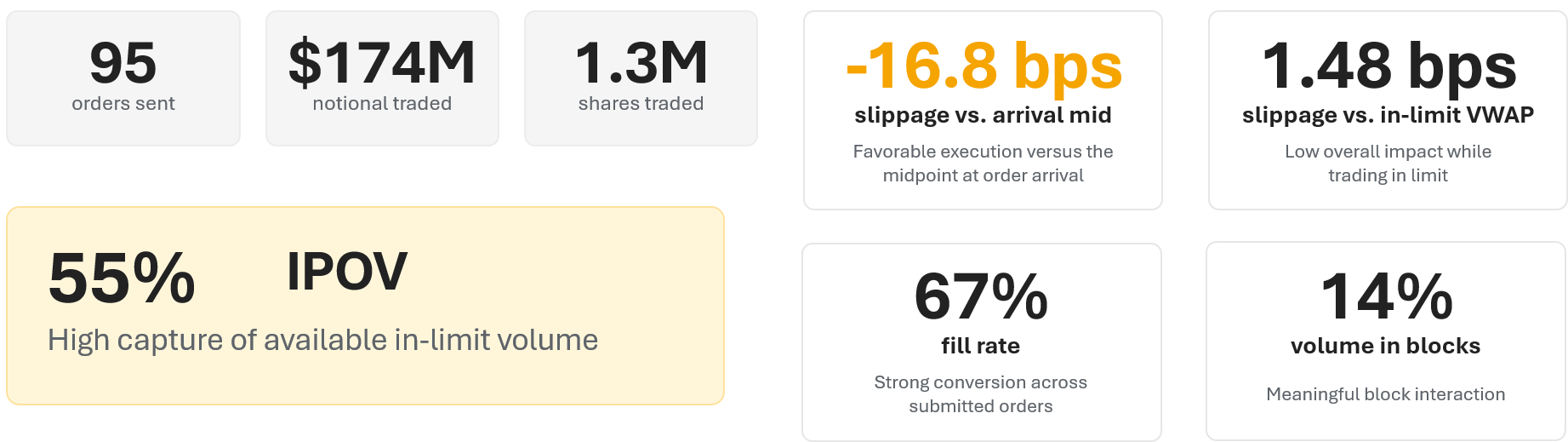
A sell-side program trading desk was recently able to capture 55% of in-limit volume across 37 distinct symbols by resting D-Peg orders on our book. While trading $174M in notional value, this basket did better than the arrival price while sourcing 14% of volume against a block contra. Also worth mentioning – this basket only had 1.5bps of slippage versus the in-limit VWAP, causing minimal impact in the market. By resting orders at the largest notional midpoint exchange, this client was able to source meaningful liquidity with only a minimal impact to execution quality.
More blocks than Victor Wembanyama
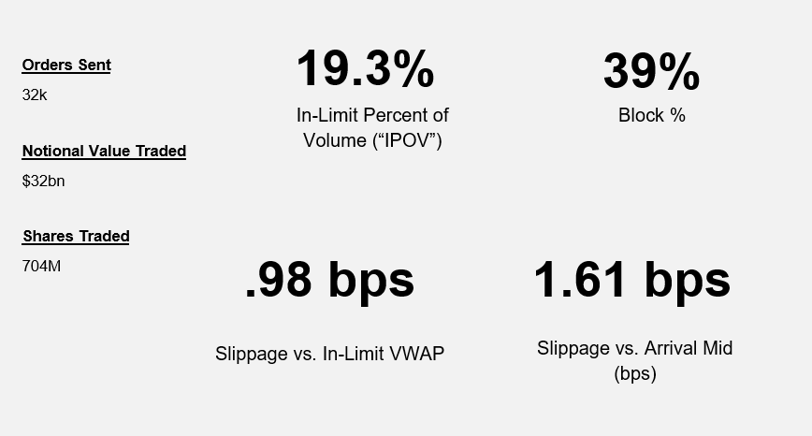
While this basket illustrates the experience of resting large orders at IEX’s midpoint, the results reflect a broader pattern among larger midpoint orders on IEX. Since the beginning of 2026, block-sized midpoint day orders that either rested on our book for at least three minutes or were fully filled within three minutes sourced over 19% of in-limit available volume, with less than 1bp of slippage versus the in-limit VWAP. And if size matters, of the volume executed by those block-sized orders, 39% was filled in block-sized trades.
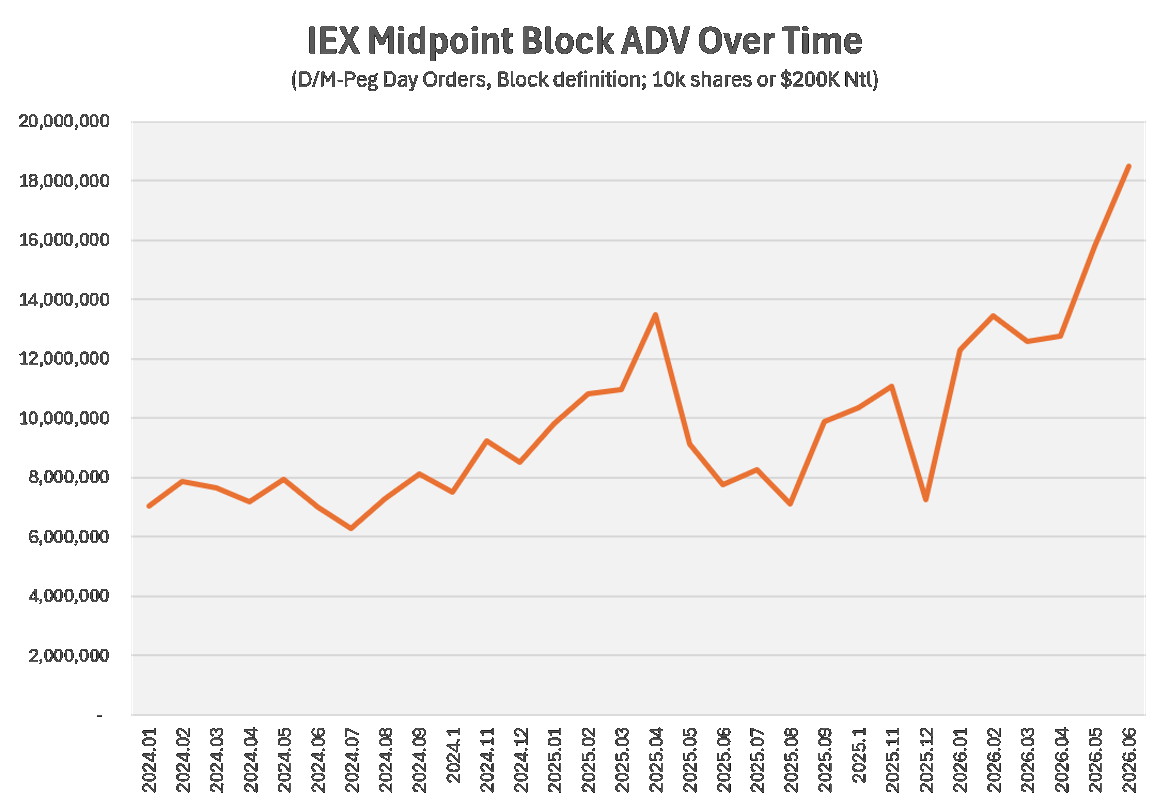
This performance has contributed to IEX's block sized trading growth in recent months. In the last three months, we saw block volumes at IEX’s midpoint increase by over 50%.
Play your game
Traders have a variety of ways to access IEX's robust midpoint liquidity within their workflows. While some traders opt to directly rest midpoint orders on our book, they more commonly access our midpoint via a liquidity seeking, dark aggregator, or scheduled algorithm. In addition, some traders have found success incorporating IEX into a conditional workflow, setting the Minimum Execution Quantity equal to the block order's size.
Good offense is good defense
Every resting pegged order on IEX benefits from speedbump protection, and D-Peg and P-Peg go a step further by also drawing on the Signal's3 protection. The Speed Bump delays incoming orders, giving IEX time to take in undelayed market data from other venues and update pegged prices to reflect the latest NBBO before executing trades. The Signal, in turn, monitors the National Best Bid and Offer and is designed to determine when prices are “unstable” or “crumbling,” i.e., likely to change. The Signal powers certain order types and can be used be used to affect trading during periods of price instability.
That protection plays out differently depending on the peg type. D-Peg and P-Peg take a protective approach, using the Signal to avoid execution during periods of elevated instability and to extract spread from more aggressively priced contra orders. M-Peg, which benefits from the Speedbump but is not powered by the Signal, is designed to capture midpoint liquidity.
IEX continues to build out tools to help traders optimize their experience, including the Ultra-Passive Signal — a good fit when you're willing to trade off some liquidity for higher-quality fills. No two baskets are the same, so IEX equips you with tools designed to offer protection for a range of situations.
Trade your next basket like a champion
IEX's distinctive liquidity and protections make it possible to source substantial fills in a stable market. Whether you're routing through an algorithm, treating IEX as a conditional venue with a high minimum execution quantity, or resting directly on our book, you have the tools to trade like a champion. Questions on how to best access IEX? Great idea to facilitate more block trading? Reach out to your sales representative or email us at bdteam@iextrading.com.
1. IEX Exchange classifications are on a best-efforts basis by member firms’ trading sessions.
2. Block liquidity refers to executions of at least 10,000 shares or $200,000 in notional value.
3. IEX Exchange’s Signal (or Crumbling Quote Indicator) is designed to identify instances when the price of a security is about to change. The Signal fires when certain deterministic factors, as specified by rule, are met. IEX Exchange’s Signal does not always fire when a quote crumbles, and it may fire in instances when a quote does not crumble.
Patrick Godfrey
Business Development