



Sometimes trading more isn’t necessarily better. Clients may prefer higher-quality fills, even if that means trading with lower fill rates. This can be particularly true for passive strategies whose performance is measured over longer time horizons, such as low-urgency liquidity seeking, or VWAP algos which are ahead of schedule.
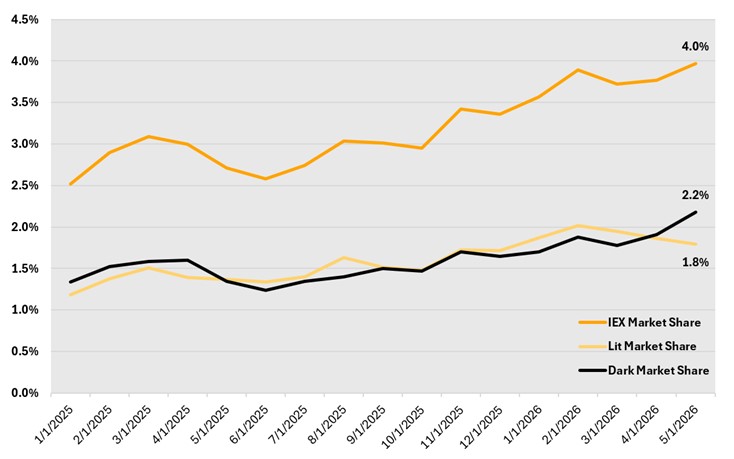
As dark trading continues to evolve, IEX continues to develop tools designed to meet shifting client needs. Ultra-Passive Signal was built for clients seeking a more selective trading approach, with a focus on execution stability and longer-horizon performance rather than maximizing fill rates alone.
An optional and additive alternative to Signal v6 for IEX’s Discretionary Peg (D-Peg) and Primary Peg (P-Peg) non-display order types, Ultra-Passive is designed to detect periods of quote imbalance and engage when those conditions resolve. When the Ultra-Passive Signal is “on,” D-Peg and P-Peg orders are prevented from exercising price discretion.
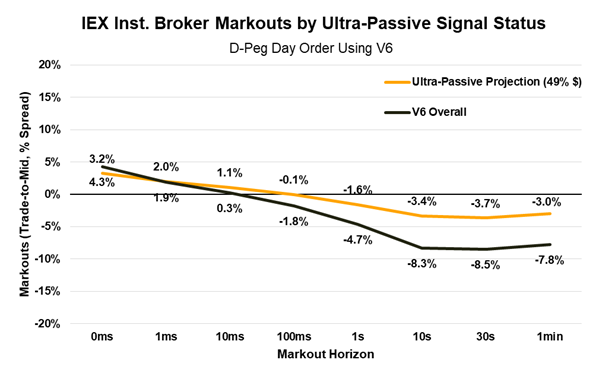
By concentrating trading activity in more opportune moments, it is designed to bring a higher degree of selectivity to help reduce adverse price movement and improve overall execution outcomes. In testing, Ultra-Passive showed meaningfully improved markouts compared to Signal v6 under similar market conditions, reinforcing the impact of greater selectivity.
Why Ultra-Passive Signal?
Passive trading strategies face a familiar challenge: sourcing liquidity that is less likely to result in adverse price movement. Many clients describe this as seeking “cleaner” liquidity, meaning executions that are less exposed to adverse selection.
Ultra-Passive Signal is designed to pursue that objective by using a more sensitive and persistent signal designed to detect quote imbalance and concentrate execution in more favorable markets.
How Ultra-Passive Differs From Signal v6
The Ultra-Passive Signal, like Signal v6, continuously evaluates real-time market data. While Signal v6 is designed to respond when a price change is imminent, Ultra-Passive focuses on identifying periods of quote imbalance and restricting discretion during them.
When Ultra-Passive is “on”:
- D-Peg and P-Peg orders do not exercise price discretion
- Orders wait until conditions normalize to resume discretion
Unlike Signal v6, which is designed to turn off discretion for 2ms, Ultra-Passive remains active for as long as imbalanced quote conditions are detected, turning off only when that security returns to a balanced state.
What This Means For Performance
That difference in approach affects execution outcomes. In testing, this approach resulted in improved markout performance relative to Signal v6 under similar market conditions.
A common way to measure execution performance is via a markout, or the direction and magnitude of a price change following a trade over a specified time frame.
By restricting discretion while imbalanced conditions persist, Ultra-Passive reduces the likelihood of execution during moments when the market is likely to move against you in the near future. As a result, the subset of trades that remained eligible under Ultra-Passive logic exhibited improved performance relative to the broader Signal v6 sample.
While this selectivity can result in fewer fills, the trades that do occur tend to align more closely with more positive trading outcomes.
Trading Less, With Purpose
Ultra-Passive Signal builds on the broader IEX execution toolkit, where different order types and functionalities are designed to support various objectives.
For example, M-Peg prioritizes maximizing midpoint liquidity. D-Peg and P-Peg are designed to prevent trades at times when instability is more likely and capture spread against more aggressive contra orders.
And while Signal v6 remains the default, the Ultra-Passive Signal optionality, applied to D-Peg and P-Peg, extends that toolkit with an even greater level of protection designed to help clients improve execution quality.
If you want to learn more about Ultra-Passive Signal, contact your sales representative or drop us a line at bdteam@iextrading.com
IEX Exchange's Ultra-Passive Signal (or Quote Imbalance Indicator)is designed to detect periods of quote imbalance in a given security. IEX Exchange's Ultra-Passive Signal does not always indicate when a quote is imbalanced, and it may indicate in instances when a quote is not imbalanced.

IEX Exchange