



In August, IEX introduced Signal V7, an enhancement to the Crumbling Quote Indicator that powers D-Limit’s protection against adverse selection.3 This upgrade also applies to any pegged orders previously using V6, including D-Peg, P-Peg, and C-Peg.
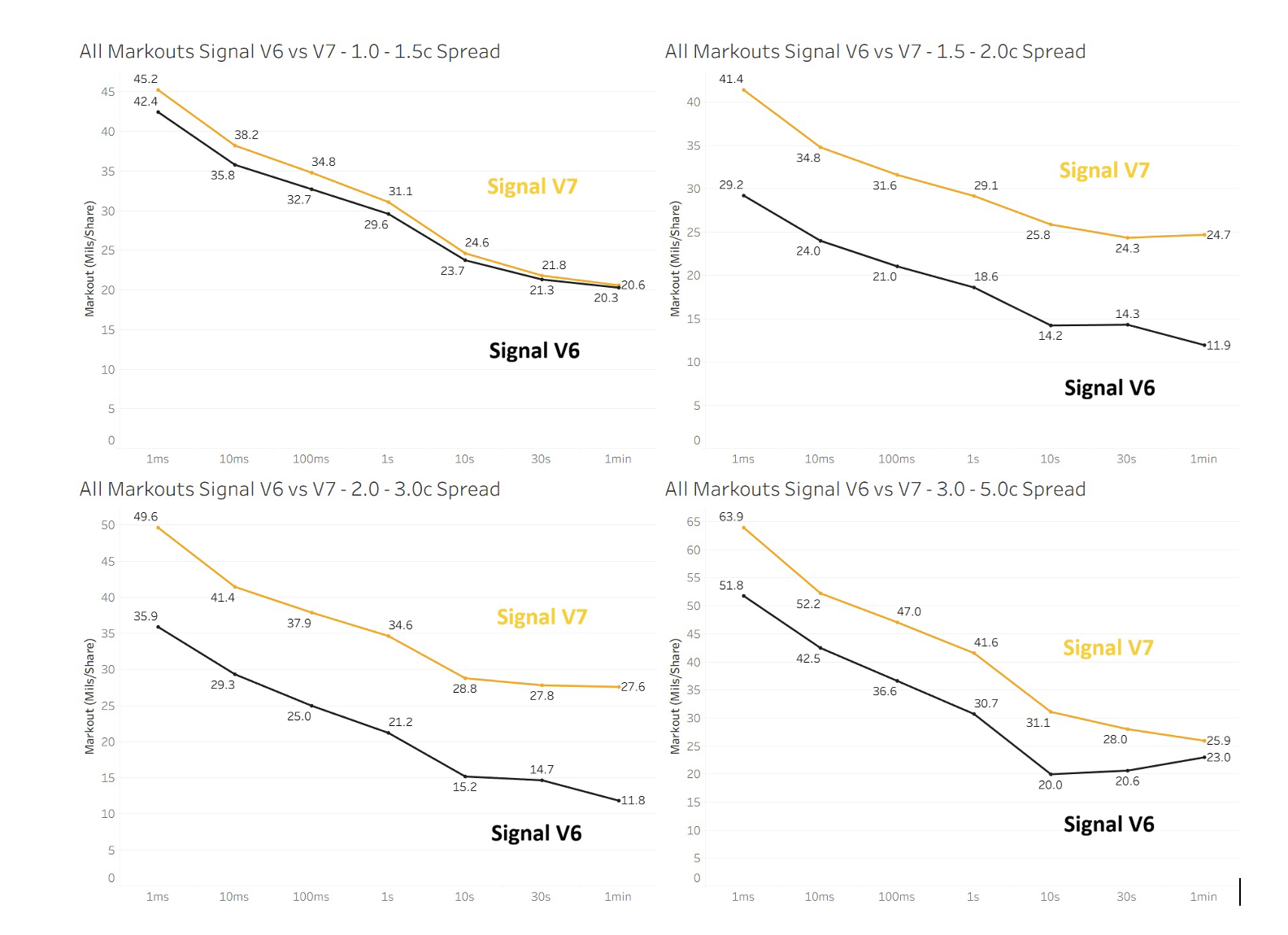
The results are encouraging. Across all four spread buckets in our analysis, V7 shows improved markouts for D-Limit Lit compared with V6. For names with an average spread between 1.5 and 3 cents, displayed D-Limit markouts improved by more than 10 mils per share at the one-second horizon.
What Changed in Signal V7? It Now References IEX’s Quote
The Signal uses quoting activity across exchanges to identify when the market is likely to move against a resting order. When it detects quote instability, D-Limit is designed to reprice your order to a more passive price to help avoid adverse selection.
V7 updates how the Signal calculates two reference prices: the Signal Best Bid and the Signal Best Offer. These represent the best protected quotations at eleven other exchanges, existing Signal Exchanges, and now include IEX’s own quote for those calculations. The nine quote-instability rules and their quoting activity inputs remain unchanged from V6.
As IEX’s quote presence has grown since D-Limit’s launch, excluding its quotation has created more situations where the Signal’s best bid and offer differ from the NBBO. This is particularly relevant in more medium- and wider-spread names, where there are often just a couple of venues quoting at the NBBO and IEX is increasingly one of them.
IEX is the Largest Quote in S&P 500 1-3 Cent Spread Names
(We were surprised by this also!)
Since introducing Signal V7, IEX has more quote size and more time at the NBBO than any other exchange in S&P 500 symbols with spreads of 1–3 cents, including the listing venues.
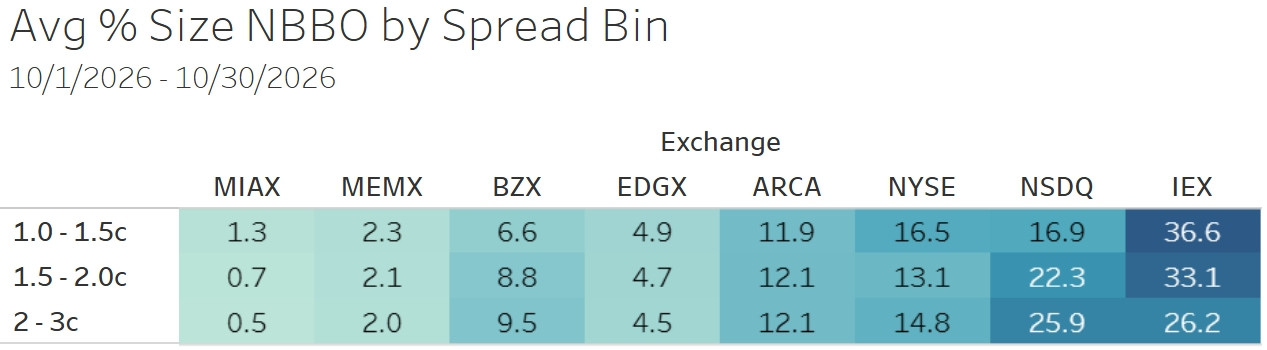

Across the S&P 500 as a whole, IEX ranks first among exchanges in both NBBO quote size and two-sided quote presence in symbols that account for more than a third of the index’s trading volume. In some of the most liquid S&P 500 names like T, NKE, F and NFLX, IEX shows more size at the NBBO and two-sided presence than any other exchange, including the primary.

That’s why leaving IEX’s quote out of the Signal’s reference prices had started to matter. In many of these names, IEX has a substantial presence at the NBBO, and the Signal’s view of the market should reflect that.
Better Markouts at Every Time Horizon
Our initial analysis compares V6 and V7 markouts across four spread ranges, from 1–1.5 cents through 3–5 cents. V7 came out ahead in every group at every measured horizon, from one millisecond to one minute.
Biggest takeaway:
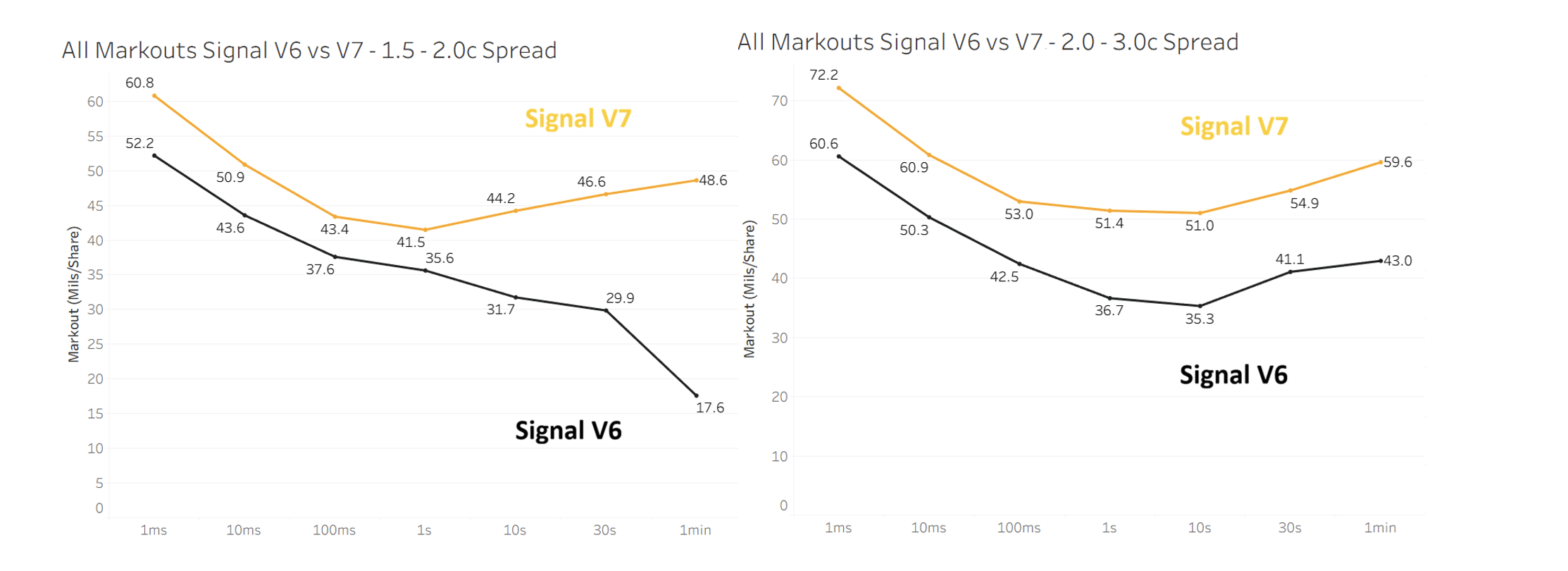
The largest gains came in the "medium" spread bucket, from 1.5-3 cents. Single stocks in these groups included NVDA, SPCX, UBER, INTC, and WMT. In those names, V7 outperformed V6 by more than 10 mils per share at the one-second horizon. Among single stocks in this spread bucket, markouts improved 9-13 mils across the time horizons shown. Including our top-tier rebate, D-Limit's all-in one-minute markouts under Signal V7 were double those under V6 in both the 1.5–2-cent and 2–3-cent average-spread bins. Improvements in execution-level performance can move the needle for your parent-level performance.
ETFs only:
The enhanced performance is noticeable in medium-spread ETFs as well. ETFs in the 1.5–3-cent average-spread groups included QQQ, GLD, EWY, XLV, and DIA. Across these groups, our analysis found markout improvements of 12-30 mils per share at horizons beyond one second post-trade.
In several spread buckets, the difference remains visible tens of seconds later.
Signal V7 requires no configuration changes, so existing D-Limit users receive the enhancement automatically.
To review how the upgrade is performing in your flow, contact your IEX representative or bdteam@iextrading.com.
1 Source: IEX Market Data,8/1–10/30/2026. Medium-spread groups are 1.5–2 cents and 2–3 cents. Markouts include the top-tier lit adding rebate of 23 mils per share.
2 For purposes of this analysis, true spread capture is defined as stable volume at the NBBO, meaning volume after which there is no change to the NBBO in the 2 ms following a trade. Comparisons are based on volume taking place at the NBBO.
3 IEX Exchange’s Signal (or Crumbling Quote Indicator) is designed to identify instances when the price of a security is about to change. The Signal fires when certain deterministic factors, as specified by rule, are met. IEX Exchange’s Signal does not always fire when a quote crumbles, and it may fire in instances when a quote does not crumble.
Timur Smirnov
Business Analytics