


.jpeg)
IEX’s displayed trading has grown materially. Our lit market share is up roughly 5x in just over two years, and our two-sided quote presence across the Russell 3000 is up more than 2.5x since Q2 2024.1
If you rank the exchanges by volume-weighted share of NBBO size or time on both sides of the NBBO, IEX now comes in second, behind only a single venue. IEX ranked first in quote size and quote presence in symbols that accounted for 36% of volume of the S&P 500.2 In many large-cap names like NFLX, BAC, and AAL, IEX has even more quote size and two-sided presence than any other exchange, including the primary exchange.
Here’s the punchline: if IEX isn’t one of your top three lit-adding venues, there’s a good chance you’re sticking out instead of blending in.
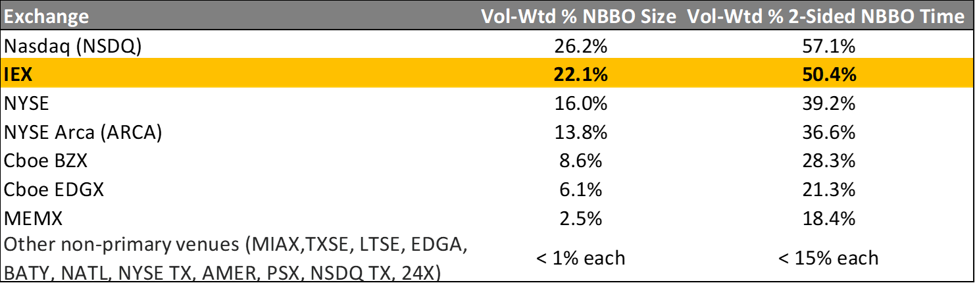
A couple of things worth evaluating:
• Blend in, don’t tip your hand. On a thick book, your displayed quote is one of many and is likely to blend in. On a smaller venue, that same quote is more likely to stand out. Stepping up your quoting there can leak your strategy. IEX now spends more time on both sides of the NBBO on a volume-weighted basis than all but one exchange, so there's real cover here.
• Look at which venues are actually in your top three. If your top displayed venues are non-primary exchanges other than IEX, it’s fair to ask what you’re getting there. When it comes to blending in or delivering true spread capture, those venues likely aren’t better.
Think your displayed trading has been getting worse? Maybe it has if you haven’t been ramping up on IEX.
Let me back that up.
D-Limit: A price better than your limit
D-Limit is the only displayed exchange order type that can execute at a price better than where your order originally rested. When our Signal3 predicts the quote is about to move, D-Limit moves your order more passively to avoid adverse selection. If the market moves, you have an opportunity to buy below or sell above your original limit.
In September 2026, 23% of institutional brokers’ D-Limit volume received price improvement, averaging 2.5 cents per share on that volume. Across all institutional brokers’ D-Limit volume, price improvement averaged approximately 59 mils per share.
That’s more than half a penny of price improvement per share on average. Imagine the positive impact that could have on your parent-order performance if your fills happened at half a penny better than your limit price.
True spread capture that doesn’t vanish right away
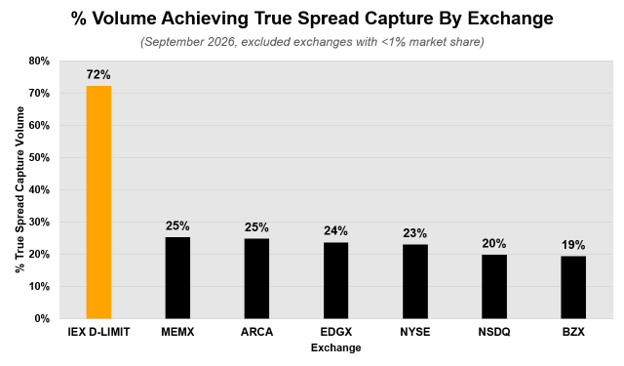
Most displayed limit orders “capture spread” only because the market is about to move against them. So, here’s the real test: when it’s 10 x 11, you are a buyer and you trade at 10, does it stay 10 x 11 (you actually captured the spread), or is it 9 x 10 two milliseconds later and you just got picked off?
With IEX D-Limit, 72% of volume delivers true spread capture.4 On other maker-taker venues, it’s essentially the inverse, with just 19–25% true spread capture.
“But D-Limit has a lower fill rate.”
It does, by design. That’s the whole point.
D-Limit prevents fills at the exact moments the Signal predicts the market is about to move against you. If a “good fill” means bidding 10 and watching it drop to 9 two milliseconds later, that’s precisely the fill D-Limit is built to help you avoid.
A lower fill rate on the trades that were likely to hurt you is a feature, not a bug.
We upgraded the Signal
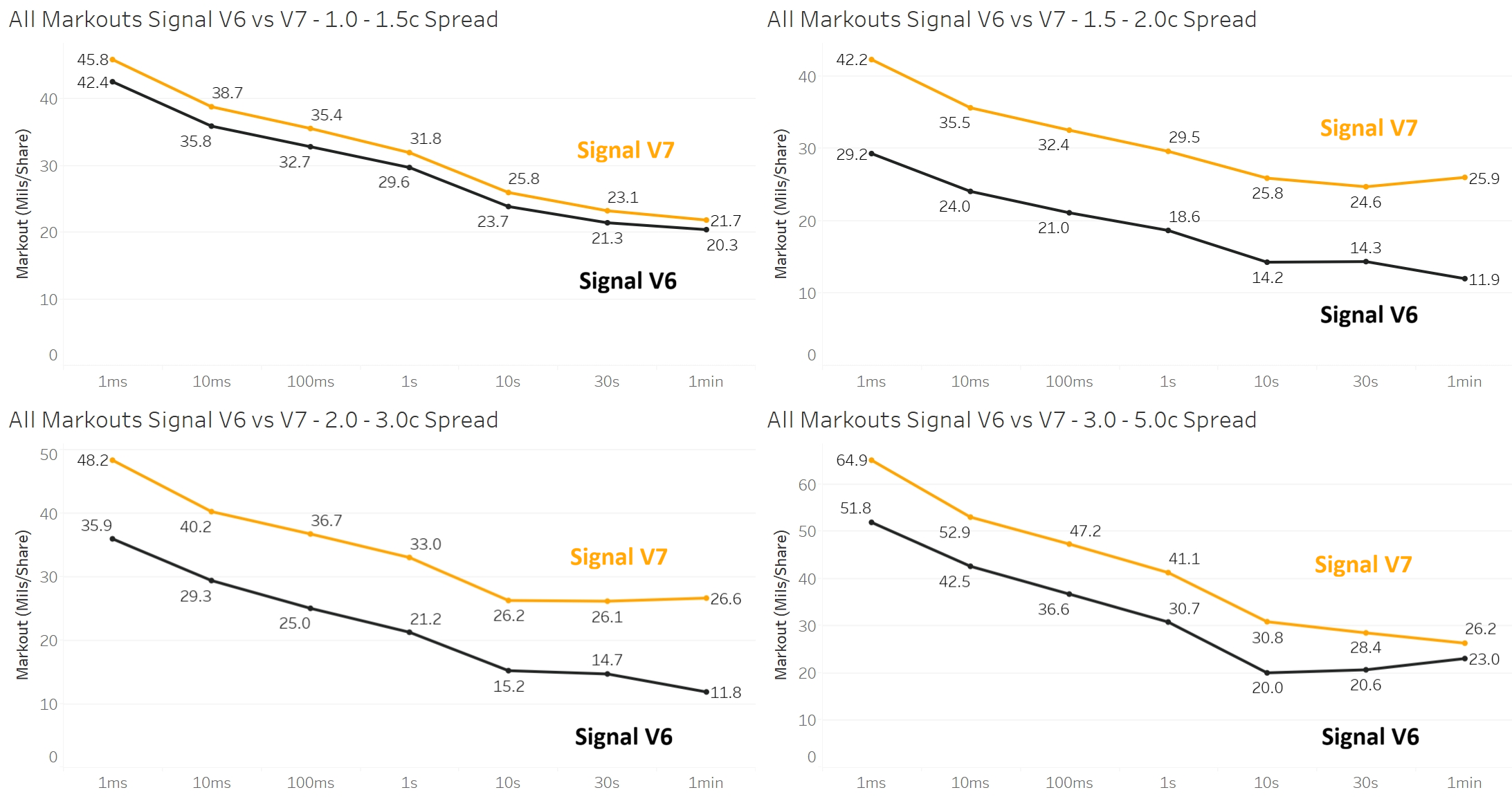
We recently deployed the latest version of the Signal behind D-Limit’s protection. We have seen our Crumbling Quote Indicator, now on V7, deliver improved markouts since it was rolled out. Stay tuned for a closer look at results in an upcoming blog.
Take another look at your displayed routing
D-Limit offers price improvement, true spread capture, and protection designed to help you avoid adverse selection. If IEX isn’t one of your top three lit-adding venues, those are reasons to take another look.
Already using D-Limit? Review how those benefits show up in your flow and parent-order performance. If you’re not, talk to us to learn more and consider where it could fit into your lit trading strategy.
If you have any questions, please reach out to your IEX rep or email bdteam@iextrading.com.
1. Reflects growth in IEX’s two-sided quote presence across Russell 3000 securities from Q2 2024 through October 9, 2026.
2. Source: NYSE TAQ Data, IEX analysis, September 2026. S&P 500 symbols in which IEX ranked first among exchanges in both NBBO quote size and two-sided NBBO quote presence collectively accounted for 36% of total S&P 500 trading volume during the period.
3. IEX Exchange’s Signal (or Crumbling Quote Indicator) is designed to identify instances when the price of a security is about to change. The Signal fires when certain deterministic factors, as specified by rule, are met. IEX Exchange’s Signal does not always fire when a quote crumbles, and it may fire in instances when a quote does not crumble.
4. For purposes of this analysis, true spread capture is defined as stable volume at the NBBO, meaning volume after which there is no change to the NBBO in the 2 ms following a trade. Comparisons are based on volume taking place at the NBBO.

Matt Weinberg
Co-Head of Equities