



• 20% of institutional broker D-Limit volume received price improvement
Six years ago, IEX introduced D-Limit, designed to deliver better-performing displayed orders, using IEX's Signal to help protect resting orders when prices are likely to change.2
Since then, more than $9 trillion in notional value has traded on IEX using D-Limit.
One of the most compelling outcomes is something a traditional displayed limit order can't achieve on its own. When D-Limit reprices during a period of predicted instability, the order can execute at a better price than where it originally rested. D-Limit is the only displayed exchange order type that enables users to achieve prices better than their initial resting price.
Those individual execution outcomes can add up over the course of a parent order. In addition to pre-trade price improvement, six years of performance data also shows what D-Limit can mean for better spread capture within a more competitive displayed market. Let’s take a look at these outcomes below.
Execution quality above and beyond: pre-trade price improvement
When IEX’s Signal predicts that a price is likely to change, D-Limit automatically reprices the order one minimum price variation (MPV) more passively than the unstable price. If the market then moves to that new price, the order can execute at a better price than where it originally rested.
In July 2026, 20% of institutional brokers’3 D-Limit volume received price improvement (getting filled at a price better than their original limit price), averaging 3.2 cents per share on that price-improved volume. Averaged across all institutional broker D-Limit volume, this translated to approximately 64 mils per share in pre-trade price improvement.
That’s more than half a penny per share in price improvement across the full population. Consider what that kind of price improvement could mean when it rolls up to parent order performance.
Spread capture that doesn't disappear in 1/100th the blink of an eye
Getting a better price than expected is a nice treat, but displayed limit orders are typically sent by firms looking to capture spread, so how good a job does D-Limit do at spread capture?
While all round lot displayed limit orders technically capture spread at the time of the trade, adverse selection is a notorious problem for this tactic. Very often, the only reason a displayed limit order can capture spread on a trade is because the market is about to move against you, and what looks like spread capture at the time of the trade will soon vanish when comparing to the market just milliseconds later.
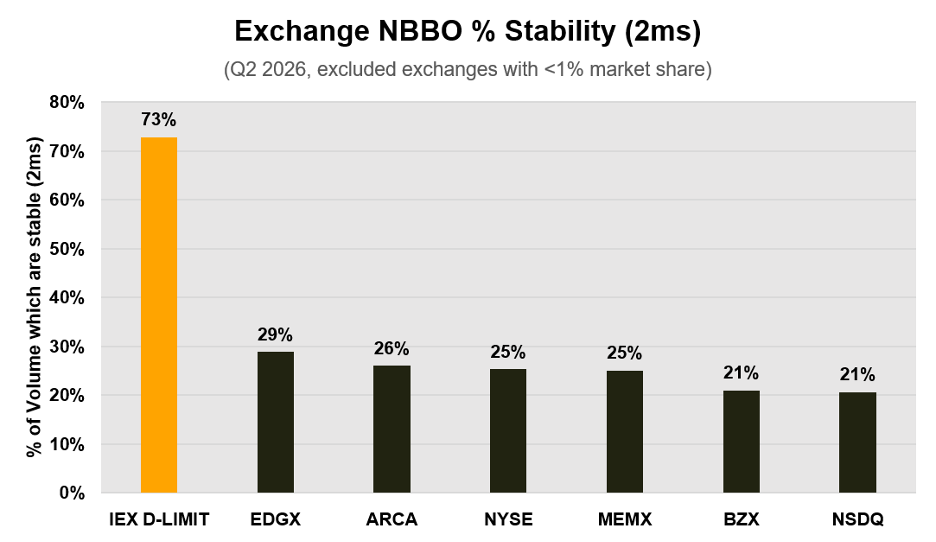
When we look at the percentage of volume occurring at the NBBO where the market was stable, meaning there was no NBBO change in the two milliseconds following the trade, we see that on other exchanges, the figure ranges from 21% to 29%.
This means that nearly three quarters of the volume on other exchanges saw the NBBO change within 1/100th of the blink of an eye.4
Contrast that with IEX D-Limit, where the figures are nearly inverted: 73% of volume is stable over the same two-millisecond period.
How does that performance stack up?
Post-trade markouts give us a way to compare D-Limit with displayed adding elsewhere.
Depending on the time horizon, D-Limit delivers on average approximately 44-49 mils per share better markouts than other maker-taker venues, excluding fees and rebates.
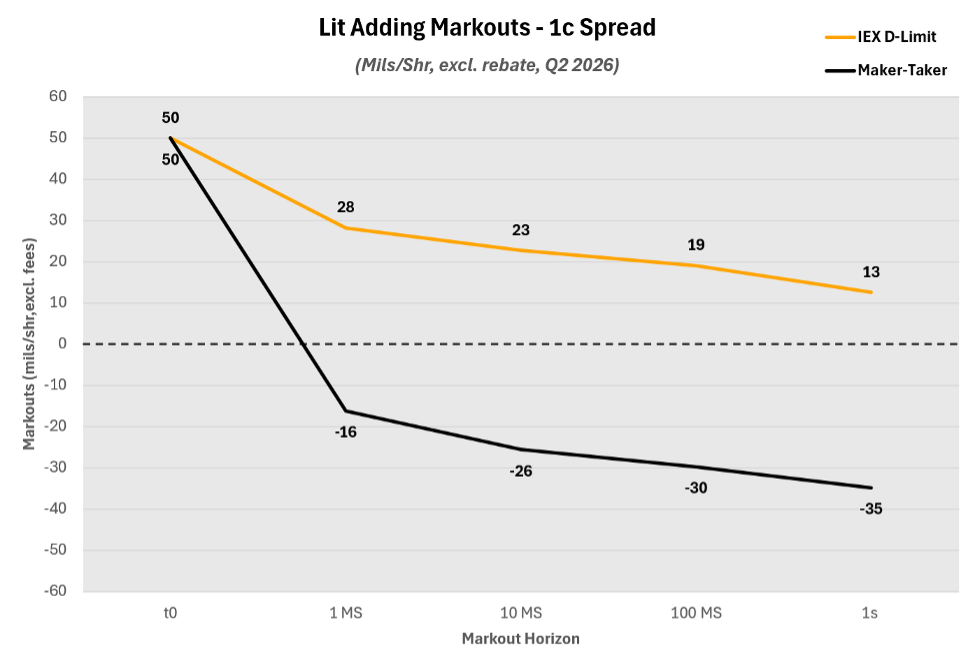
D-Limit also continues to deliver positive markouts one second after the trade, while displayed adding on other maker-taker venues does not. That post-trade performance matters when evaluating the economics of a displayed execution alongside the rebates offered by maker-taker venues.
Competing at the inside
D-Limit was built for the displayed market, and that market on IEX has changed considerably over the past two years.
IEX Lit Market Share has grown substantially, while IEX's two-sided quote presence across Russell 3000 securities has increased more than 2.5x since Q2 2024.
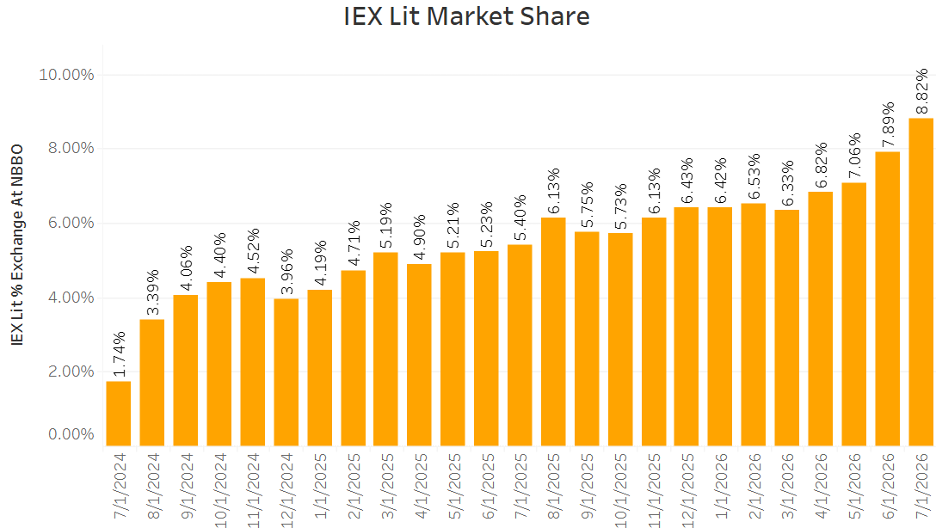
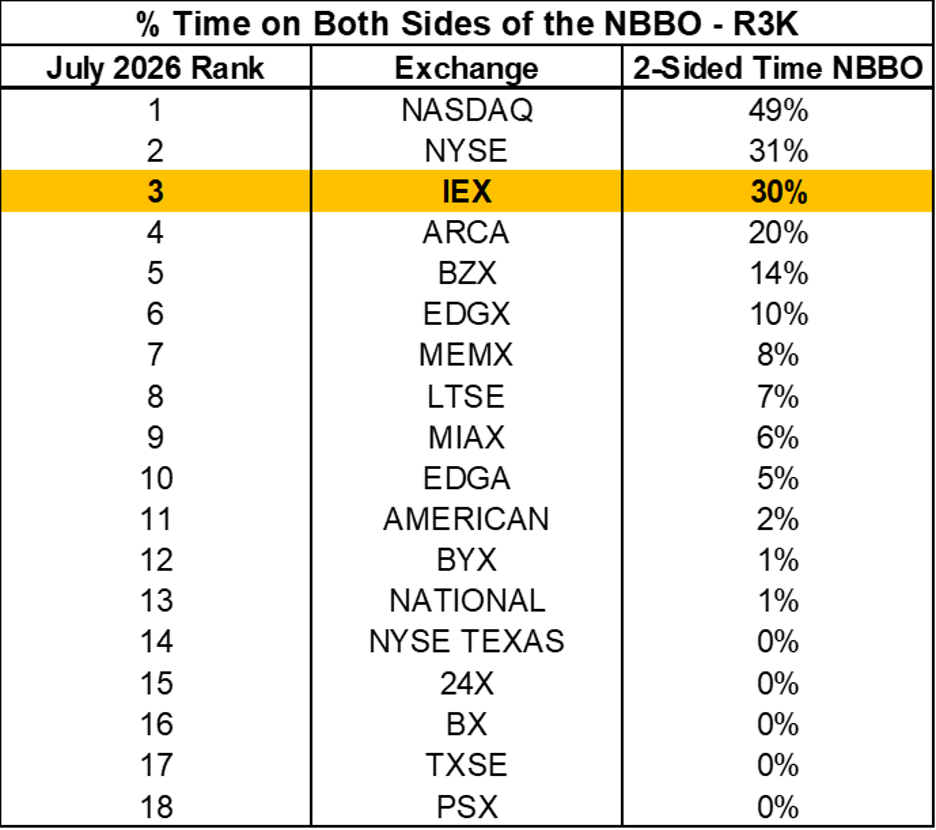
This growth in quote presence matters in a less obvious way, too: it makes it easier to post displayed liquidity without standing out.
Something we hear from clients is that even on a venue with good performance, if that venue is seldom quoting at the best prices, an increase in quoting activity can cause information leakage and possibly signal one's trading strategy.
IEX, however, spends more time on both sides of the NBBO in Russell 3000 constituents than all but two exchanges, both primary listing venues. This can allow individual quotes to blend into a thicker order book, giving liquidity providers a measure of cover that a smaller venue cannot offer.
Additionally, IEX’s displayed market share has grown 5x in just over two years. With more displayed volume executing on IEX, algos have greater opportunity to participate as volume trades on the Exchange.
More time at the inside creates more opportunities for providers to put D-Limit to work and for takers to interact with displayed liquidity on IEX.
How is D-Limit performing for you?
Reach out to your IEX sales representative or email bdteam@iextrading.com to review the latest performance data with our sales and analytics teams and learn where D-Limit could play a larger role in your displayed trading strategy.
1 For purposes of this analysis, true spread capture is defined as stable volume at the NBBO, meaning volume after which there is no change to the NBBO in the 2ms following a trade. Comparisons are based on volume taking place at the NBBO. (Q2 2026.)
2. IEX Exchange’s Signal (or Crumbling Quote Indicator) is designed to identify instances when the price of a security is about to change. The Signal fires when certain deterministic factors, as specified by rule, are met. IEX Exchange’s Signal does not always fire when a quote crumbles, and it may fire in instances when a quote does not crumble.
3. IEX Exchange classifications are on a best-efforts basis by member firms’ trading sessions.
4. Source: https://pmc.ncbi.nlm.nih.gov/articles/PMC4043155/
5. IEX Lit Market Share = IEX Lit Volume / On-Exchange at NBBO Volume